Your Brand's Voice: Train AI to Speak for You
Your brand has a unique voice. With AIVEXLO, you're ensuring your AI speaks exactly the same language, maintaining consistency and authenticity in every interaction. Your AI partner is an extension of your identity. #BrandVoice #Authenticity #AIVEXLO
Is your brand missing the opportunity to have a unified and unmistakable voice across all digital interactions?
In a market where differentiation is crucial, communication inconsistency is a costly mistake.
Companies spend thousands of euros building an identity, but often fail to replicate it, especially when emerging technologies like Artificial Intelligence come into play.
The question is not whether to use AI, but how to ensure that your AI doesn't sound like "just another" generic AI, but rather an authentic extension of your own brand.
This article will unveil the methodology to empower your AI to communicate with your brand's unmistakable voice, transforming every interaction into a reinforcement of your identity and values.
The Silent Cost of Brand Voice Inconsistency
Imagine a potential customer interacting with your brand through a social media ad, then receiving an email, and finally speaking with a chatbot on your website.
If each of these touchpoints presents a different tone, lexicon, and approach, the perception of professionalism and trust crumbles.
Inconsistency is not just an aesthetic issue; it's a factor that erodes loyalty and credibility.
Consequences of Inconsistency:
- Identity Dilution: The brand's core message becomes diffused.
- Loss of Trust: Customers distrust brands that appear "bifurcated" in their communication.
- Marketing Ineffectiveness: Marketing efforts lose impact when the voice is not cohesive.
- Hidden Operational Costs: The need for corrections and rework to align communication.
Why Training Your AI is More Than Just "Setting a Tone"
Training AI to replicate your brand's voice goes far beyond simply indicating "formal" or "informal".
It implies careful engineering of language, context, and nuance.
It's like teaching a new team member to internalize the company's culture and way of expression before putting them in contact with clients.
AI, by its nature, is a scaling tool. Without proper personalization, it can amplify mediocrity, generating generic content that gets lost in the digital noise.
However, when well-trained, AI becomes an authenticity accelerator, capable of generating millions of interactions that sound genuinely "yours".
Methodology for Imbuing Your AI with Brand Identity
The process of "giving voice" to your AI requires a structured approach. It is not a one-time event, but rather a continuous cycle of refinement and learning.
1. Audit and Definition of Existing Brand Voice
Before training the AI, it is crucial that your team has a crystal clear understanding of the brand voice.
- Current Content Analysis: Review emails, blog posts, sales communications, and marketing materials. Identify patterns of vocabulary, sentence structure, tone (humorous, serious, empathetic, etc.), and points of view.
- Creation of a Style and Voice Guide: Formally document the elements of your brand's voice. Include:
- Brand Personality: Adjectives that describe it (e.g., innovative, accessible, authoritative).
- Tone: How the brand sounds in different contexts (e.g., formal for proposals, more relaxed for social media).
- Forbidden and Preferred Vocabulary: Terms that should never be used and industry- or brand-specific terms.
- Grammar and Punctuation Rules: Specifics that the brand adopts.
- Practical Examples: Text excerpts that exemplify the ideal voice and the voice to avoid.
2. Curation and Preparation of Training Data
Data quality is fundamental. AI is only as good as the data it is trained with.
- High-Fidelity Data: Collect text examples that represent your brand's ideal voice. This may include:
- Successful sales emails.
- Popular blog articles.
- Model customer responses.
- Transcripts of presentations or speeches.
- Contextual Diversity: Ensure that the data covers different communication scenarios (marketing, sales, support, public relations) so that the AI learns to modulate its tone appropriately.
- Cleaning and Annotation: Remove noise, errors, and irrelevant content. If necessary, annotate the data to highlight specific elements of the brand voice.
3. Continuous Training and Refinement with AI Micro-applications
With AIVEXLO's B2B AI operating system, this process becomes more cohesive and effective.
- Language Modeling: Feed the AI with the style guide and curated data. AIVEXLO's AI micro-applications are designed to absorb these nuances and apply them across various functions.
- Iteration and Feedback: The initial training phase is just the beginning. Monitor the AI's output, gather feedback from the team and customers, and use it to refine the model.
- Contextual Adjustments: The AI must learn to adapt the brand's voice to different contexts. For example, a response to a complaint requires a different tone than a message celebrating customer success.
| Brand Voice Feature | Traditional Approach (Manually) | Optimized Approach (With Trained AI) |
|---|---|---|
| Consistency | Dependent on individual writer | Automated and scalable across all interactions |
| Scale | Limited by human capacity | Unlimited, capable of generating vast cohesive content |
| Response Time | Variable, subject to revisions | Instant, maintaining authenticity |
| Contextual Adaptation | Requires constant supervision | Continuous learning and self-adjustment |
| Cost | High in labor and review | Reduced in the long term, resource optimization |
💡 Expert Practical Tip: Don't try to train your AI to be all of your brand's voices at once.
Start with a specific domain, such as prospecting emails or FAQ responses, and refine the voice in that context before expanding to other areas.
Initial specialization accelerates learning and minimizes errors.
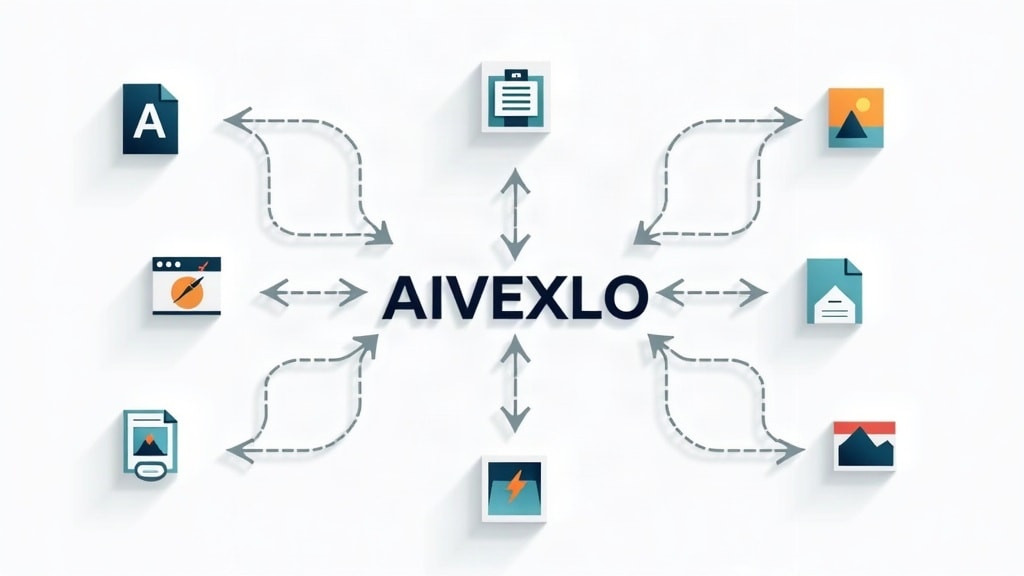
The Transformative Impact of AI with Your Brand's Voice
A well-trained AI to speak for your brand is not just an automation tool; it is a strategic asset that:
- Strengthens Loyalty: Customers feel a stronger connection with brands that communicate consistently and authentically.
- Optimizes Lead Generation: Aligned and personalized messages capture attention and convert more effectively.
- Improves Customer Experience: Quick responses with the brand's voice increase satisfaction.
- Frees Up Human Resources: The team can focus on higher-value tasks, while AI manages routine communication with authenticity.
With AIVEXLO's B2B AI operating system, companies can integrate this capability seamlessly.
AI micro-applications work together to ensure that from content creation to prospecting and sales, your brand's voice resonates, transforming every click into revenue.
It is the bridge between your identity and your business growth.
Conclusion
Your brand's voice is its distinguishing mark, what makes it memorable in a sea of competition.
Ignoring the importance of training your AI to replicate that voice is to relinquish a crucial competitive advantage.
By investing in the personalization of your AI, you are ensuring that every digital interaction is not only efficient but also deeply authentic and aligned with your company's values.
Your AI should not just be a tool, but a consistent and powerful ambassador for your brand.
It's time to ensure your AI doesn't just "talk," but "talks like you." Contact us at support@aivexlo.com to discover how AIVEXLO can empower your company to achieve this perfect symbiosis between technology and identity.
Frequently Asked Questions (FAQ)
Q: How long does it take to train an AI for my brand's voice?
A: The time varies depending on the complexity of the brand's voice and the quantity and quality of available training data.
However, with platforms like AIVEXLO, which offer specialized AI micro-applications, initial results can be visible in weeks, with continuous improvements over time through feedback and refinement cycles.
Q: Is it possible for AI to make mistakes and use an inappropriate tone?
A: Yes, especially in the initial stages. AI learns through repetition and correction.
It is essential to have a monitoring and feedback system to quickly identify and correct any deviations from the desired tone.
Human supervision is crucial for continuous refinement and to ensure that AI aligns perfectly with the brand's voice.
Q: Can AI adapt the brand's voice for different audiences or platforms?
A: Absolutely. Well-trained AI can learn to modulate tone and style based on context, target audience, and communication platform.
For example, it can use a more informal tone for social media and a more formal tone for business proposals, provided it is properly fed with examples and guidelines for each scenario.
Business Brain: Your Personalized AI
Build an exclusive digital brain trained with your brand identity and voice. Analyze data and generate elite content.
Edmundo Isidro
Co-founder & CTO
Helps businesses and entrepreneurs implement intelligent automations and scale their revenue through elite artificial intelligence solutions.